
Break Free from Societal Pressure: Redefine Your Success 2026
Stop Living Someone Else's Life
“If you don’t design your own life plan, chances are you’ll fall into someone else’s plan. And guess what they have planned for you? Not much.”

Rachel & Sophie, walking down to the beach in Le Pouliguen, France, to explore the coastline.
This article was updated on March 7, 2026
About the Author
Colleen is a Gen X mom, full-time traveler, and the storyteller behind Uncommon Family Adventures. Since 2024, she and her husband, Kevin, have been traveling the world full-time with their three daughters (a young adult and two teens) across 15+ countries and 4 continents, while homeschooling on the road and documenting every honest, unfiltered mile of it.
Before the bags were packed, Colleen spent 20+ years navigating the very societal pressures she writes about: the career ladder, the school schedules, the white-picket-fence checklist. She didn't just read about stepping off the conventional path. She sold the house, pulled the kids from traditional school, and did it.
She writes this post from a guesthouse in Kuala Lumpur, Malaysia, which is exactly the point!
Why Following the Script Might Be Holding You Back
Ever feel like you're playing a role in someone else's bad script? Society has handed us a cookie-cutter life plan: college, career, marriage, mortgage. But what if you're ready to rewrite it and create a life that's truly yours?
The truth is, societal pressures act like an invisible hand pushing us all toward a one-size-fits-all existence. This isn't just about the pressure to get good grades or go to college. It's about the deeper expectation that our lives should fit into neatly defined boxes.
Breaking free from societal expectations is possible when you take intentional steps to redefine success on your own terms.
The Pressure Starts Earlier Than You Think
As parents, we've experienced the weight of societal pressure firsthand. I'll never forget the moment we walked into Sophie's kindergarten orientation and saw a sign that said, "Welcome Class of 2030! Let's Get College-Ready."
Seriously? She's five. Her biggest concern should be which crayon to use, not SAT prep.
The pressure to conform begins long before kids can even understand what it means. And yet, this blueprint for life is handed to most of us, whether we wanted it or not. It's as if life is supposed to follow a preordained structure, and questioning it is somehow irresponsible.
The American Psychological Association’s Stress in America 2025 (November 6, 2025) report found that 62% of U.S. adults now cite societal division itself as a major source of stress. That's before you layer on the pressure to follow the "right" life script.
The APA also found that living in a society obsessed with division, comparison, and achievement is grinding people down across all age groups. A 2025 study in Frontiers in Psychiatry confirmed that anxiety and its triggers are now landing on teens and young adults simultaneously, meaning families like ours are absorbing the weight from multiple directions at once, often without anyone naming what's actually happening.
When we decided to step off that treadmill, we weren't just doing it for us, as parents. We were doing it for all five of us.
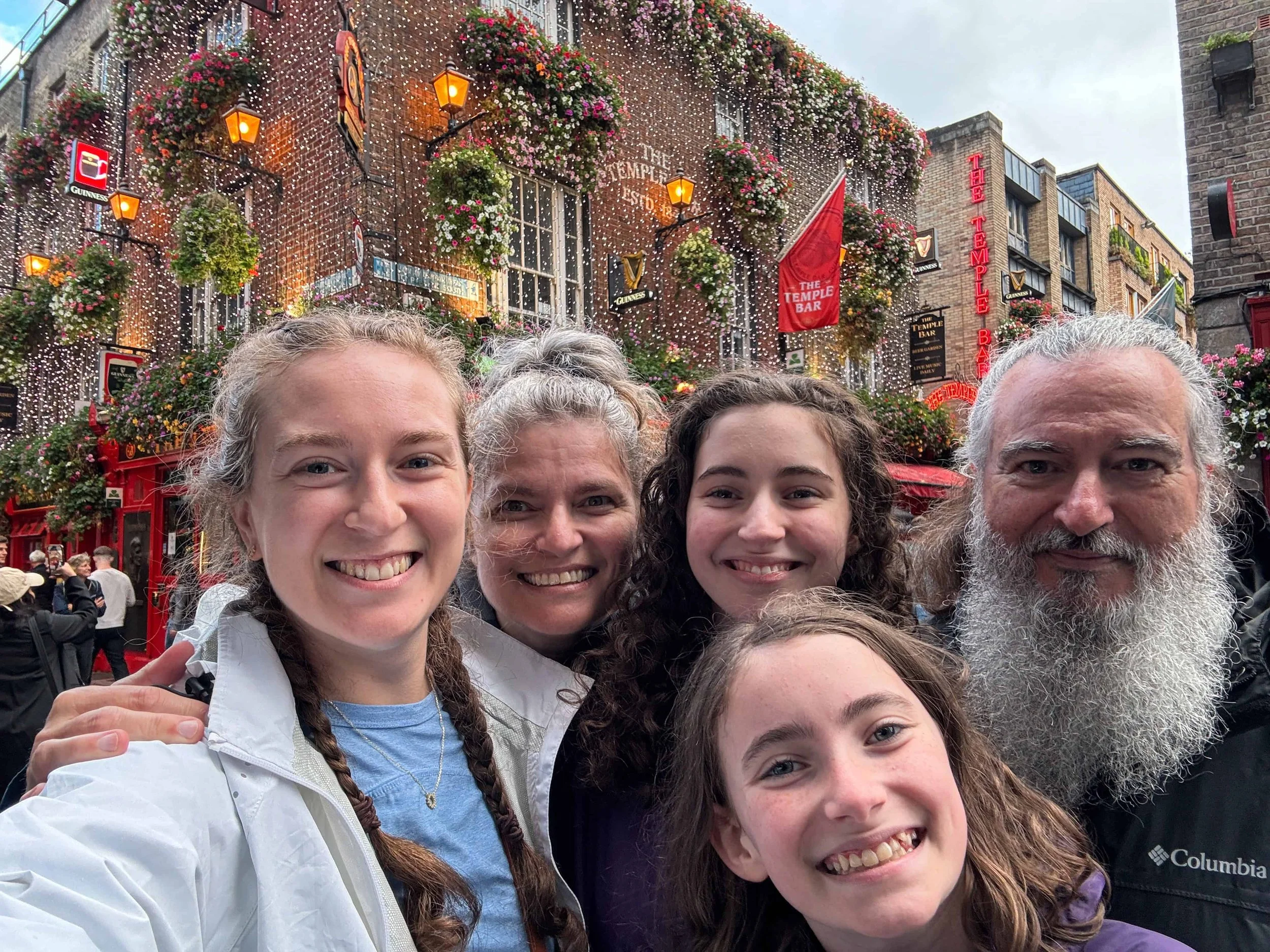
Enjoying time as a multigenerational family near The Temple Bar in Dublin, Ireland.
The Fear of Being Different
Many of us feel the pull to stay on the prescribed path, even when it doesn't fit. In 2026, we live in a world where career success is equated with financial wealth, where social media feeds create false realities of perfection, and where deviating from the norm is often met with confusion or quiet judgment.
In our family, as we travel the world with our kids, we often hear, "I wish I could do that." But the honest truth is that many people feel trapped in jobs or routines they don't love because they've been told this is the only road to a "successful" life. Who decided that a house with a white picket fence equals success? And why are so many of us bankrupting ourselves trying to prove it?
What Societal Expectations Actually Look Like
The external pressures are real and specific. Society's version of success tends to follow a tidy sequence: go straight from high school to college, get a steady job, buy a house, start a family, and retire. But this version of success might not match your personal dreams, or your family's.
The assumption that college is the right move for every young person, regardless of what they actually want, is one of the clearest examples of this pressure. According to the National Center for Education Statistics, a significant percentage of students who begin a four-year degree don't complete it, yet the cultural push to enroll immediately after high school hasn't slowed.
I recently came across a Facebook post from a friend whose son had decided to leave college before finishing his first semester. Her post was a plea to friends to be kind to him and not judge him too harshly as he figured out what he wanted.
I was disheartened that she felt she needed to defend his decision. But I was genuinely impressed by his maturity in recognizing that college wasn't the right fit for him at that stage, and by his courage in saying so. I found myself imagining a world where his community patted him on the back and cheered him toward his better path instead.
The Fear of Ruining Everything
On a deeper level, there's the fear that if we don't follow the prescribed path, we're somehow ruining our lives. What if we fail? What if our unconventional choices lead to regret?
Researcher Brené Brown, in her widely viewed TED Talk The Power of Vulnerability, argues that vulnerability is actually the birthplace of innovation and joy. Yet most of us have been taught to avoid it at all costs to sidestep shame, fear, and failure.
We're all terrified of failing, of judgment, of becoming the cautionary tale at the family dinner table. But here's the thing: what's worse than failing is never trying.
In our family, we believe the opposite of conventional wisdom tends to be true. To live authentically, to take the road less traveled, is to truly unlock the happiness and fulfillment we all crave. That conviction is precisely why we set out on our Uncommon Family Adventures.
"To live authentically, to take the road less traveled, is to truly unlock the happiness and fulfillment we all crave."
5 Signs You're Trapped by Societal Pressure
You Feel Out of Place for NOT Following the Crowd
If you regularly feel like you're "doing something wrong" because your lifestyle, career choice, or opinions differ from the majority, that's worth examining.
What if you saw that discomfort as a sign you're thinking for yourself?
Constant Comparison
Measuring your life against others' careers, relationships, or material success is a reliable sign that external norms are running the show.
What if your contrarian choices were a measure of your conviction and strength instead?
Decisions Based on Others' Expectations
If you're making choices out of fear of judgment rather than because they feel right, you're living someone else's life.
What if you felt genuinely empowered by seeking your own path?
Guilt Over Skipping Conventional Milestones
Feeling ashamed for not hitting the expected markers, marriage, homeownership, and a stable 9–5, can indicate you've absorbed cultural norms that may not actually fit you.
What if you wore those differences as a badge of honor instead?
Fear of Expressing Your True Self
If you hold back your real identity or genuine beliefs to avoid social rejection, that fear is rooted in the pressure to conform.
What if you surrounded yourself with people who challenge you to be your best and cheer you on every step of the way?
How Our Experience Can Help You Be the Hero of Your Own Story
When we decided to leave behind our conventional lives in favor of full-time family travel, it wasn't just about seeing new places. It was a conscious choice to stop being bullied by societal pressure and start living on our terms.
Our first real test came in France. We spent three months exploring the country, and while we hit the traditional tourist sites in Paris, most of our time was spent in small villages, eating in restaurants where we were often the only non-locals in the room.
Nobody handed us a translated menu or slowed down their French for our benefit. We had to learn enough of the language to function, not perfectly, but well enough. It was uncomfortable in ways a one-week vacation never forces you to be. For example, we spent two weeks in Nice, France, living among the locals. We walked to get groceries; we interacted with non-English-speaking French workers, and that discomfort turned out to be exactly the point.
We failed, too, and more than once. Early on, we tried to keep a traditional school and work calendar while traveling, cramming structure into a lifestyle that didn't fit it. The stress was unnecessary and self-imposed. We slowly let go of the arbitrary rules that once governed our time, and when we did, something shifted.
We found learning methods that went deeper than anything a rigid schedule had ever produced. We started homeschooling in 2021 and then customized our learning to incorporate worldschooling methods. New knowledge was applied in the world around us, not just on a worksheet.
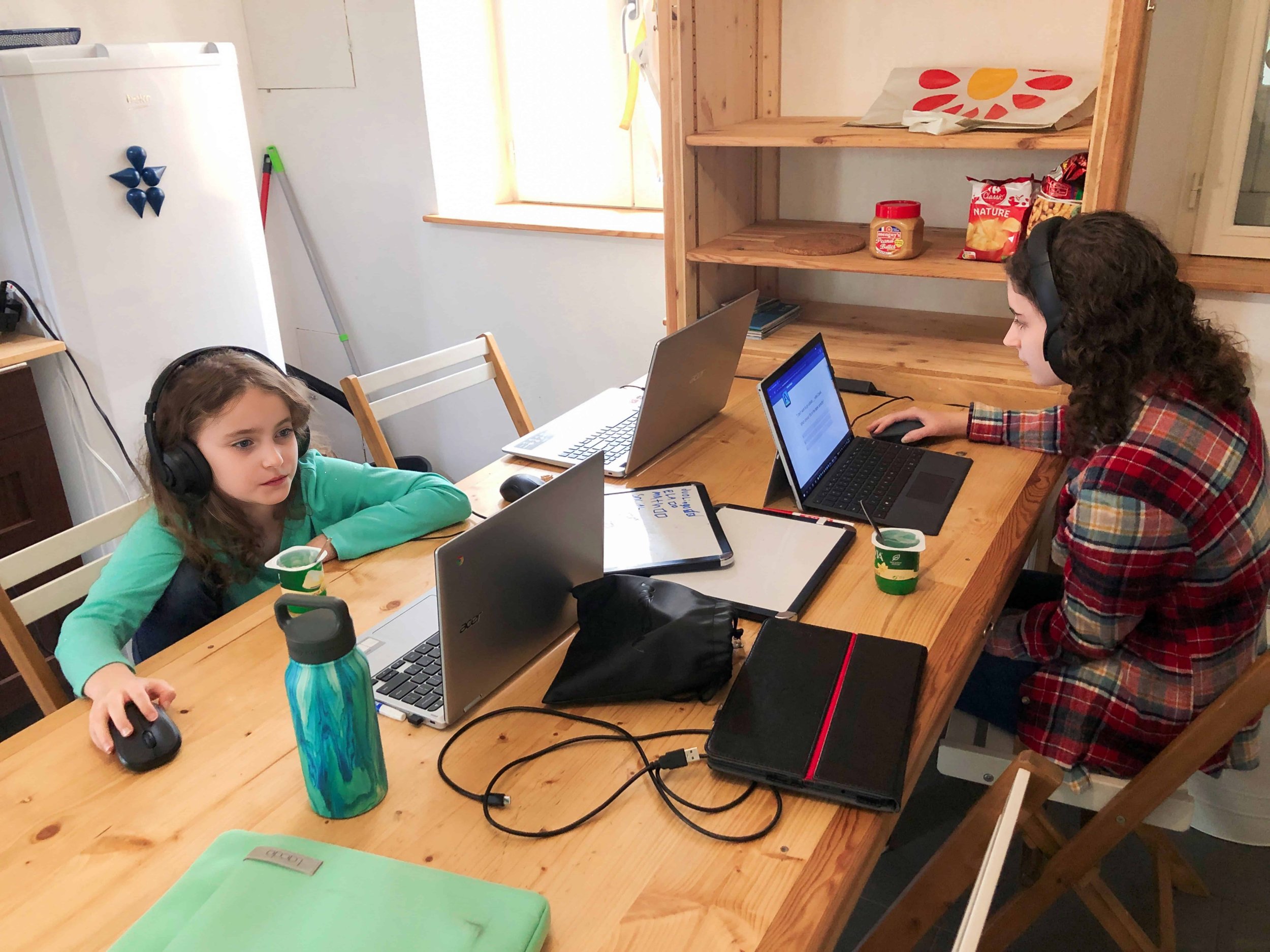
Sophie & Rachel, doing schoolwork at an Airbnb in Étretat, France.
Research on worldschooling (Scientific American, 2024, October 21). Worldschooling Is Catching On. Here's What You Need to Know) shows that children often gain key emotional competencies, such as handling risk, cultural communication, and adaptability, that prepare them for an uncertain world, often outweighing gaps in traditional schooling.
In 2024, we found ourselves in Asia, a continent that had once felt genuinely intimidating to us. We took a very big step into the unknown. We explored Jakarta, Bangkok, Taipei, and Kuala Lumpur, navigating cities where almost nothing was familiar.
We turned the challenge of building connections into one of our greatest unexpected wins. Embracing expat communities and staying open to chance conversations changed everything. A doctor's assistant has gone from being a stranger to a friend over the last year. Ellie maintains a growing list of young adults she’s been slowly connecting with over recent months.
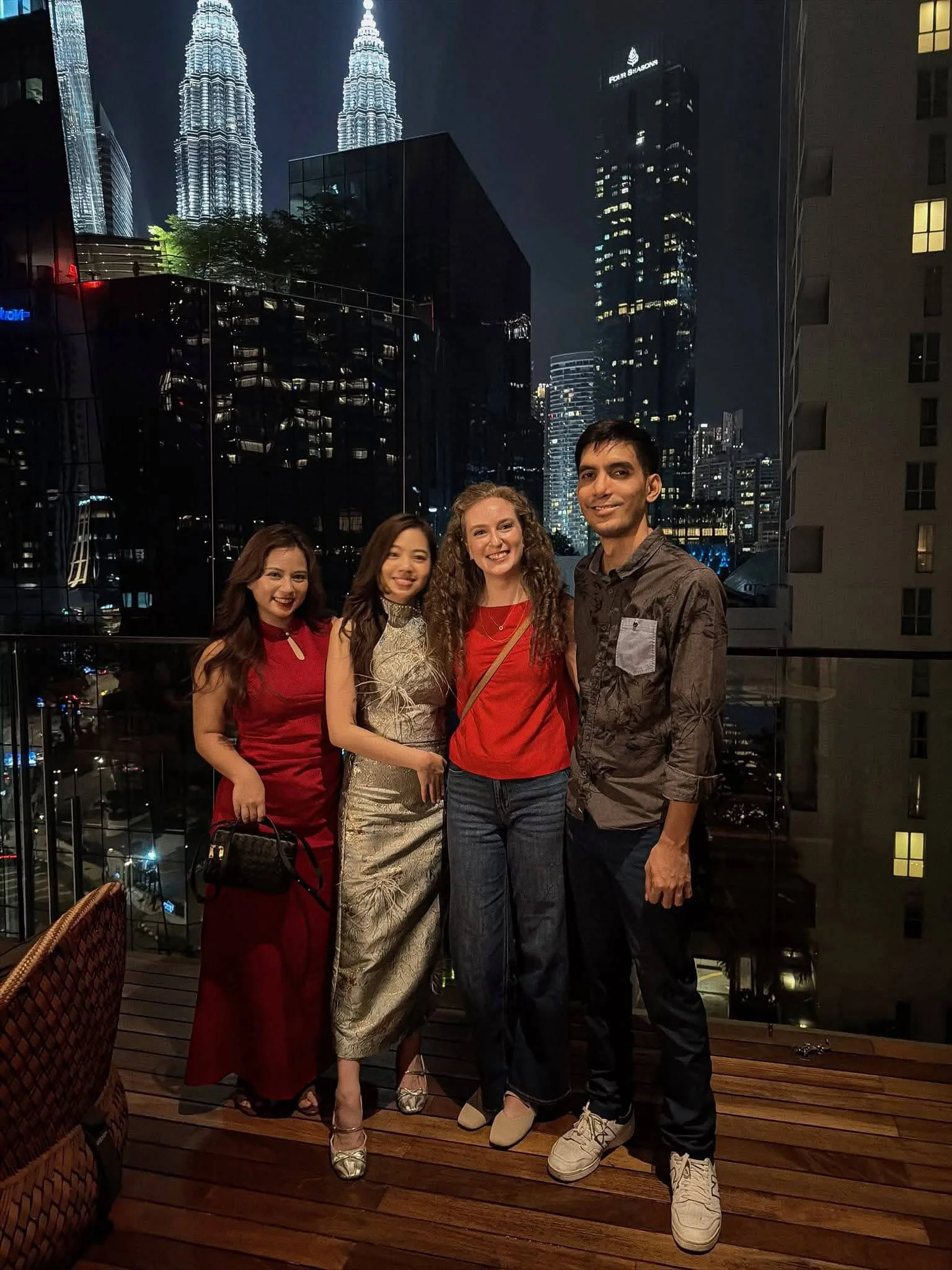
Ellie, celebrating the Lunar New Year with some of her friends from the Expat Group in Kuala Lumpur, Malaysia.
This kind of connection reveals something important: we have far more in common with strangers across the world than we ever imagined. A continent that once felt out of reach has become something close to home.
Travel has given us the freedom to explore our passions, connect with people from all walks of life, and build memories that actually matter.
It's taught us to embrace uncertainty and let go of the fear of failure. It's also allowed us to model independence and real-world problem-solving for our girls every single day.
Our path has confirmed what we suspected all along: there is no one-size-fits-all solution to happiness. Our family's happiness is not dependent on following anyone else's script.
Even if full-time travel isn't your family's dream, our goal is to show you that there is another way. A way where you can reclaim your personal path without the weight of someone else's expectations hanging over you.
How to Define Success on Your Terms in 2026
Reclaiming your path doesn't have to be overwhelming or immediate. It starts with small, intentional steps.
Redefine Success
Ask yourself: "What does success actually mean to me?" Stop chasing someone else's version of the good life. There is no single formula. You get to write it.
Embrace Vulnerability
Stepping off the beaten path is genuinely scary. But remember, vulnerability is the birthplace of creativity and joy. Trust that daring to define and pursue your own dreams brings you closer to what you actually want.
Start Small
If a radical life change feels overwhelming, begin with tiny adjustments that align with your values. Dedicate an hour a day to a passion project. Cut down work hours to spend more time with your family. We started with a three-week road trip, then a three-month international trip, before finally launching our full-time family travels.
Build Your Tribe
Seek out people who get it. Spend time with those who challenge you to define and pursue your passions and cheer for you every step of the way. The Psychology of Supportive Relationships is well-documented. Community is one of the most powerful predictors of well-being and resilience when you're doing something unconventional.
Let Go of Fear
Failure is not the end. It's just part of the process. Achieving anything meaningful requires taking risks. You will fail along the way. But failure is feedback, not a death sentence. Reframing it frees you from the grip of perfectionism and gets you back on your own path faster.

Exploring near the iconic Mont-Saint-Michel in Normandy, France.
Live Authentically & Reclaim Your Happiness
Here's the honest truth: you've got one life. Are you going to spend it stuck in society's hamster wheel, or are you going to step up and live it on your terms?
The choice is yours.
It's time to stop being bullied by someone else's blueprint. You have the power to design your life, and that starts with understanding there is no "right" way to live. It's about finding what works for you.
"The only expectations that matter are your own."
As you begin to step out of the cycle of conformity, you'll discover that the path to happiness isn't a straight road. It's a winding, thrilling journey that's entirely yours to create.
Will you take the first step toward your own adventure? Share one step you'll take today to reclaim your happiness. Tell us in the comments below!
If you're ready to stop following someone else's script, come do it with us. Our complimentary weekly newsletter is where we share the unfiltered version of living your script.
We share what full-time travel with teens and a young adult actually looks like, the detours we didn't plan, and the moments that remind us why we chose this. Authentic, real, and nothing like you have read before.
FAQ: Breaking Free from Societal Pressure
What is societal pressure?
Societal pressure is the invisible influence from family, culture, media, and peers pushing us to follow a "standard" life script. Examples: college right after high school, steady 9–5 job, marriage, house, kids, retirement. It starts early and creates fear of being "different" or failing. We felt it most when choosing full-time travel over conventional routines. Yet breaking free showed us happiness isn't one-size-fits-all.
How do I stop caring what others think?
Start by recognizing that most people are too focused on their own lives to obsess over yours. It is a freeing truth. Replace critical inner voices with supportive ones; surround yourself with a "tribe" who cheers your authentic path, not judges it. Practice small acts of vulnerability daily, and reframe judgment as feedback rather than failure. We learned: when you live true to your values, the right people stay, and the rest fade. Focus on pleasing your future self, not today's audience.
How can I redefine success on my own terms?
Redefining success begins with honest self-reflection: What truly lights you up (family connection, freedom, growth, impact)? List your core values (ours: adventure, presence, independence), then measure success against them, not society's markers like wealth or titles. Ask: "Does this choice align with my joy?" Start small, dedicate time to passions, or cut draining routines. Our shift to full-time family travel proved that success isn't a destination; it's about living authentically every day.
Why do we feel trapped by societal expectations?
We feel trapped because these expectations feel like the only "safe" path. Questioning them risks judgment, failure, or regret. Social media amplifies perfection myths, and fear of missing milestones (marriage, homeownership) creates guilt. Yet many regret conformity more than deviation.
Is it possible to break free without ruining everything?
Yes! Breaking free doesn't require dramatic upheaval; it starts with intentional, low-risk steps. Test alternatives (cut work hours for family time, try a passion project) while maintaining stability. Our journey began with short trips before going full-time. Failure is feedback. Build a supportive community that celebrates your choices. The road less traveled often leads to the richest destinations.
How does societal pressure affect families?
It pressures families to follow the same blueprint: early college, conventional careers, settled life, often at the expense of connection and joy. Parents feel guilt for skipping milestones; kids absorb stress from "success" timelines. In our case, societal norms made full-time travel seem irresponsible until we saw the benefits: real-world learning, stronger bonds, and independence.
The research and data referenced throughout this post come from the following authoritative sources:
American Psychological Association. (2025, November 6). Stress in America 2025. American Psychological Association. https://www.apa.org/news/press/releases/stress/2025/stress-america (Reports that 62% of U.S. adults cite societal division as a major stressor.)
Frontiers in Psychiatry. (2025). Anxiety Disorders in Adolescents and Young Adults: Converging Risk Factors and Clinical Implications. Frontiers in Psychiatry. https://www.frontiersin.org/journals/psychiatry (Confirms that anxiety triggers are now landing on teens and young adults simultaneously.)
National Center for Education Statistics. (2024). Undergraduate Retention and Graduation Rates. U.S. Department of Education, Institute of Education Sciences. https://nces.ed.gov/programs/coe/indicator/ctr (Tracks completion rates for students who begin four-year degree programs.)
Scientific American. (2024, October 21). Worldschooling Is Catching On. Here's What You Need to Know. https://www.scientificamerican.com/article/worldschooling-is-catching-on-heres-what-you-need-to-know (Discusses the growing trend of families educating children through world travel, highlighting emotional and adaptive benefits beyond traditional schooling.)
Brown, B. (2010, June). The Power of Vulnerability [Video]. TED Conferences. https://www.ted.com/talks/brene_brown_the_power_of_vulnerability (Argues that vulnerability is the birthplace of innovation, creativity, and belonging.)
Personal experiences and observations of Colleen, author of the Uncommon Family Adventures blog (2021–2026). Documented in real-time from locations including France, Indonesia, Thailand, Taiwan, and Malaysia.
