
10 Proven Tips for Affordable Family Travel with Teens (2026)
How to Plan Amazing Family Trips on a Budget Without Going Into Debt
“You Don’t Have to Be Rich to Travel Well.”

We thoroughly enjoyed our Autumn day exploring the Palace of Versailles and its gardens, where kids under 18 are FREE!
Last Updated: February 21, 2026
Let's be honest: family travel with teens and young adults is expensive. Your kids eat more, need more space, and want to do more than they did at age 6. A "quick getaway" can easily cost thousands of dollars, and that credit card bill can turn post-vacation bliss into financial stress real fast.
According to Fool.com’s recent study, the average cost of a vacation in 2025 reached $7,249, up nearly $1,400 (or 11%) from 2024, with lodging and food accounting for the bulk of expenses. For 2026, the average cost of a vacation is forecasted to be nearly $8,000! Add in international flights, and you need a small personal loan to cover all expenses.
If you've been putting off affordable family travel with teens because the price tag feels impossible, you're not alone. But here's the thing: we've been traveling full-time as a family of five across 15+ countries for over two years, and we've figured out how to make it work without going into debt. For example, our recent trip from San Francisco to Singapore on a direct flight with Singapore Airlines cost all five of us only $28. (Yep, just over $5 each.)
The strategies below aren't theoretical. They're the exact methods we use to keep our family on the road while staying within budget.
Why Family Travel Costs with Teens Get So Expensive
Before we get into the tips, let's talk about why family travel gets so expensive in the first place.
The School Calendar Trap. Most families are stuck traveling during summer break, Thanksgiving, Christmas, and spring break when everyone else is traveling too. Hotels and airlines know this and jack up prices accordingly.
Airline Nickel-and-Diming. Airlines charge for everything: carry-ons, checked bags, and seat selection. When you're buying five tickets instead of two, those fees add up fast.
Hotel Room Limits. Most hotel rooms outside the U.S. only accommodate three people. Larger families end up booking multiple rooms, which can double or triple lodging costs.
Food Adds Up. Feeding a family of five at restaurants gets expensive quickly, especially when your teens can put away food like it's their job. Even fast food can run $10+ per person if you're not careful.
With all of these cost drivers working against you, it's no wonder families feel priced out of travel the moment their kids hit middle school. But there are ways around every single one of these obstacles.
10 Tips to Make Family Travel with Teens More Affordable
Choose Your Destination Wisely
Not all dream destinations are created equal in terms of cost. Before you get attached to a specific location, spend time comparing similar destinations at different price points. Look beyond flights and accommodations and factor in the day-to-day cost of living, restaurant prices, activity costs, and the number of free or low-cost options available.
If a European city trip is the goal, Bratislava, Budapest, or Porto will stretch your budget significantly further than Paris, Rome, or London while still delivering that "wow" experience your teens are after. A beach trip to Myrtle Beach will cost a fraction of Nantucket. There's almost always a comparable destination that delivers the same experience for less.
For more on European gems, check out our 16 Reasons to Visit Normandy, France with Kids.
| Destination Pair | High-Cost Option (e.g., Paris) | Budget Alternative (e.g., Porto) | Estimated Savings |
|---|---|---|---|
| City Break | $500/night lodging | $300/night lodging | 40% |
| Beach Vacation | Nantucket ($400/day activities) | Myrtle Beach ($150/day) | 62% |
| European Adventure | London ($200/meal for family) | Budapest ($100/meal) | 50% |
We’ve spent many months over the last two years exploring Southeast Asia. While locations like Singapore are quite expensive, your money goes much farther in locations like Kuala Lumpur, Jakarta, and Bangkok. While Asia always felt intimidating to us, once we traveled there, we realized just how welcoming these countries are and how much easier it is to navigate than we had anticipated.

Many of our favorite affordable destinations are located in Southeast Asia. We loved exploring the largest mosque in SE Asia, as well as the various temples in Bangkok & Kuala Lumpur (clockwise from top left: family selfie at Masjid Istiqlal, Wat Phra Kaew, Wat Arun, Reclining Buddha at Wat Pho, & Batu Caves).
Travel During the Off-Season or Shoulder Season
The single most effective way to reduce travel costs is to go when everyone else isn't. The off-season and shoulder season (typically spring and fall in most destinations) offer dramatically lower prices on flights, accommodations, and even popular attractions. Smaller crowds are a bonus. With off-season family vacations, we’ve cut costs by up to 50%.
If your teens are in school, this strategy takes some planning, but it's worth exploring. Many school administrators are more flexible than families expect when approached thoughtfully. A few suggestions for making it work:
Know your state's laws and your school's policies before assuming absences are impossible. Some districts have real flexibility, especially for families with a plan in hand.
Communicate proactively with teachers and administrators. Be direct about the dates, how long you'll be gone, and how your teens will keep up with their work. Having an administrator's support makes the teacher conversations much easier.
Ask for assignments in advance. Teens are more than capable of knocking out reading, writing, or review work on a long flight or during a slow afternoon at a rental. Planning ahead rather than hoping for the best is the key.
Ask about credit for the trip itself. Many teachers are genuinely receptive to a well-written travel report or a short presentation that connects the experience to coursework.
As a family that has homeschooled for several years, I can tell you that kids can absolutely get school done in interesting places. It's not always the most fun part of travel, but staying on top of it means your child won't be behind when they return.
For families who can’t pull kids out, consider extended breaks like Presidents’ Week.

Autumn was the perfect time to visit Colmar, France. We avoided the large crowds that visit during summer when kids are out of school & during winter when the Christmas Markets are in full swing.
Start a Family Travel Savings Account
Consistent, small contributions add up faster than most people expect. If family travel is a priority, treat it like one and give it its own dedicated account. Automatic transfers of even a modest amount per paycheck, combined with a few small lifestyle trade-offs, build real momentum toward your next trip.
It doesn't have to be a formal bank account. A visible jar or container that the whole family can contribute to and watch grow serves the same psychological purpose. The point is to make the goal concrete and ongoing, not a one-time scramble right before booking.
Take Advantage of Travel Perks You Already Have
If your family has a membership to a local zoo, aquarium, museum, or theme park, there's a good chance it offers free or discounted admission at affiliated locations across the country and sometimes internationally. Many institutions have partnership agreements that offer free or discounted admission elsewhere. The Association of Zoos & Aquariums (AZA) and the North American Reciprocal Museum (NARM) Association both maintain networks of participating institutions that most families never think to check.
We benefited from this for many years through our Busch Gardens Williamsburg annual passes, which also covered admission to its sister parks around the country, including SeaWorld locations in Orlando, San Antonio, and San Diego. Before any trip, do a quick check on the memberships you already hold and look up what perks transfer.
For our family tips on visiting Williamsburg, VA, head over to Williamsburg with Kids.
Use Miles and Points Strategically
Flights and accommodations are almost always the two biggest line items in any family travel budget. If frequent travel is a priority, travel-friendly credit cards are one of the most powerful tools available. The benefit isn't just from welcome bonuses (though that is the fastest way to boost points balances). It comes from the accumulation of everyday spending over time.
The Key Rule: Points and miles only benefit you if you're paying your statement balance in full every month!
For family-friendly travel rewards options, check NerdWallet's travel rewards guide. It is a solid starting point for comparing card options if this is new territory for you. Used correctly, this strategy can cover (or lower) the cost of flights and hotel nights for a family that's otherwise paying out of pocket for everything. We’ve redeemed points for nonstop, deeply discounted international airfares (less than $100 per person) multiple times over the past 2 years.
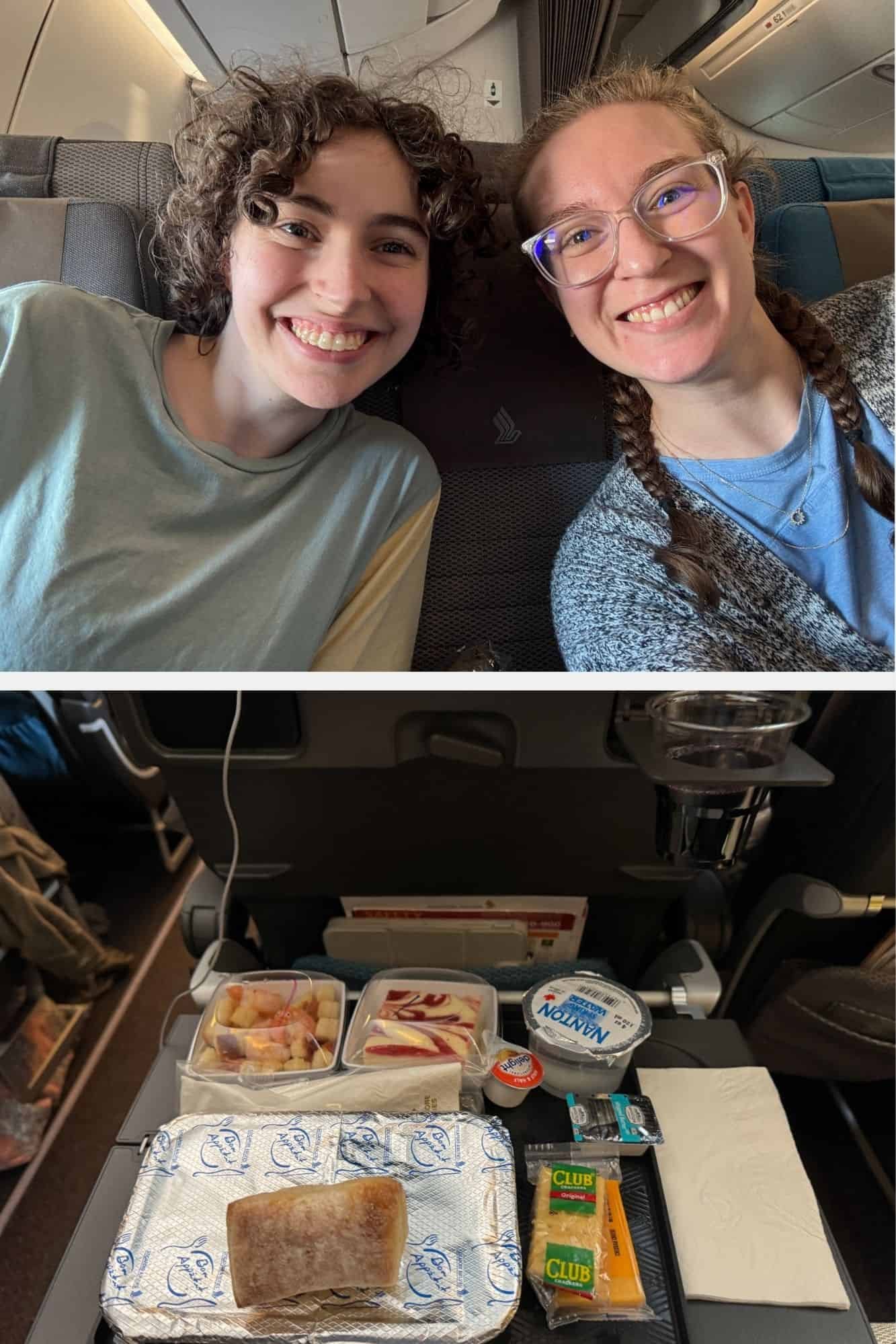
Rachel & Ellie on our Singapore Airlines flight from San Francisco to Singapore. We enjoyed 3 meals during the 16.5-hour journey. All for a grand total of $28, thanks to credit card miles & points!
Rethink Family Accommodations
Hotels are rarely the best option for families traveling with teens and young adults. Most are designed for 2–3 guests, and paying for additional guests or booking two separate rooms quickly inflates the cost. For families whose teens are done sharing beds, the math gets even worse.
Look for cheap family accommodations on platforms such as Airbnb and VRBO, which frequently offer better space for the price than two hotel rooms. TrustedHousesitters is another strategy we've used extensively as full-time travelers. It minimizes accommodation costs in exchange for caring for someone's home and pets.
Hostels with private family rooms are also worth considering, especially in Europe, where they're often well located and surprisingly comfortable. We stayed in a hostel during our trip to Dublin.
For a peek into our Dublin, Ireland experience, check out Top Family-Friendly Activities in Dublin.

We absolutely loved our stay at Ashfield Hostel in Dublin, Ireland! With a private family suite, we were situated just steps from Trinity College.
Get Serious About Saving on Food
Food is often where the best-laid travel budgets fall apart. The moment hunger strikes and everyone's mood drops, good intentions go out the window. Planning ahead is the only reliable defense.
Choosing family accommodations with a kitchen, even a small one, is the single most impactful decision a family can make on food costs. Being able to prepare breakfast and at least one other meal per day, at your own pace, with food you've chosen, dramatically changes the financial picture. As a general target, we aim for $5 per person per meal.
We also typically eat two substantial meals per day rather than three while traveling, which reduces both cost and the constant logistical overhead of finding a restaurant that works for everyone. A filling late breakfast or brunch, followed by a well-rounded dinner, covers nutritional needs without the expense of a sit-down lunch every day. Splurging on the occasional pastry or gelato mid-afternoon becomes more fun if you’re saving money elsewhere in the budget.
Packing snacks is another habit that consistently pays off. Portable, easy options like fruit, granola bars, nuts, peanut butter sandwiches, and trail mix keep everyone fueled between meals without impulse purchases at tourist-area prices.

Some of our favorite sweet & savory treats that we simply couldn’t say “no” to!
Make Intentional Trade-Offs
Sustainable travel on a real budget isn't about cutting everything down to the bare minimum. It's about knowing where you're willing to spend more and offsetting those costs elsewhere. A splurge on a special experience or a nicer dinner is completely compatible with a travel budget as long as it's planned for.
An expensive flight can be offset by a week in a TrustedHousesitters property. A few big-ticket days in a pricier city can be balanced by choosing a slower, lower-cost destination for the days before and/or after. The goal is intentionality, not deprivation. Teens especially benefit from the occasional experience that's worth the spend. It's part of what makes the trip memorable.
Use Public Transportation
If your family primarily travels within the U.S., the breadth and quality of public transportation in other countries can be genuinely surprising. In most European cities, commuter trains and buses are faster, cheaper, and more convenient than renting a car, paying for parking, or relying on rideshare apps.
Many cities offer multi-day transit passes that cover unlimited travel for a set price, often available directly through the city's official tourism site. In Paris, for example, the Paris Visite pass covers the metro, buses, and RER trains and pays for itself quickly when you're moving around the city every day with a family.
We spent six weeks in a suburban neighborhood outside Melbourne, Australia, and didn’t have a car for most of that time. We walked to nearby stores and took the train into the city for fun family outings, where we utilized Melbourne’s free tram zone. We even got some experience traveling by bus during our stay. We loved not having to search and pay for parking in the city. It made our day trips more efficient and less expensive.

Melbourne, Australia, had a great public transportation system that we used during our visit. From trains & buses to the free downtown tram zone, everything was easy to navigate!
Search Out Family Discounts, Especially in Europe
This one surprises many families the first time they discover it. Across Europe, children and teenagers under 18 receive free admission to many of the world's most iconic and visited sites. This includes the Louvre and the Palace and Gardens of Versailles, two of the most visited attractions on the continent.
For our experience at the Louvre, check out Our Visit to the Louvre.
Beyond individual-site discounts, many cities offer passes that bundle admission to multiple attractions over several days at a reduced total price. These require some advance planning to use effectively, but for families with teens who want to pack in experiences, they're often excellent value.
FAQ: Family Travel Savings Strategies
How do families afford to travel with teenagers on a budget?
By prioritizing off-season trips, using points/miles, and cooking in rentals, as outlined in our tips. Start with a dedicated savings account.
What's the cheapest way to travel with a family of 4 or 5?
Opt for budget destinations like Porto over Paris, use public transport, and leverage reciprocal memberships for free attractions.
Is it cheaper to travel to Europe or domestically with a family?
It depends, but Europe can be affordable with discounts, e.g., free entry for kids under 18 at sites like the Louvre.
How do you save money on food while traveling with teens?
Aim for $5/person/meal by cooking in kitchens and packing snacks; eat two main meals daily.
Planning Family Travel on a Budget Is a Skill You Build
The good news is that none of this requires a perfect budget or a high income. It requires a shift in how you think about the planning process: starting earlier, being more flexible on timing, and making intentional choices about where the money goes. With rising costs in 2026 (projected revenue growth in travel and tourism worldwide), these family travel with teen savings strategies are more crucial than ever.
Traveling with teens and young adults brings a different set of costs than the younger years did. But it also brings a different level of engagement, curiosity, and genuine connection. The investment is worth it.
What are your best strategies for keeping family travel affordable as your kids get older? Drop your tips in the comments. We'd love to hear what's worked for your family.
If you found this helpful, join our UFA Community newsletter for weekly travel tips, destination guides, and behind-the-scenes updates from wherever we are in the world.
About the Author
Colleen is a full-time traveler, Gen X mom, and the voice behind Uncommon Family Adventures. She's been traveling internationally with her three daughters (ages teen to young adult) and her husband, Kevin, for over two years across 15+ countries.
Colleen shares the real strategies her family uses to travel affordably with teens and young adults without going into debt. For more, visit About Us
This post contains affiliate links. If you purchase through a link on this page, we may earn a small commission at no extra cost to you. Thank you for supporting Uncommon Family Adventures! / Colleen & Kevin
